How to Choose Chanderi Fabric
Reading count, sheen and hand before you commit a collection to Chanderi — a buyer's guide to the weave that looks simple and behaves anything but.
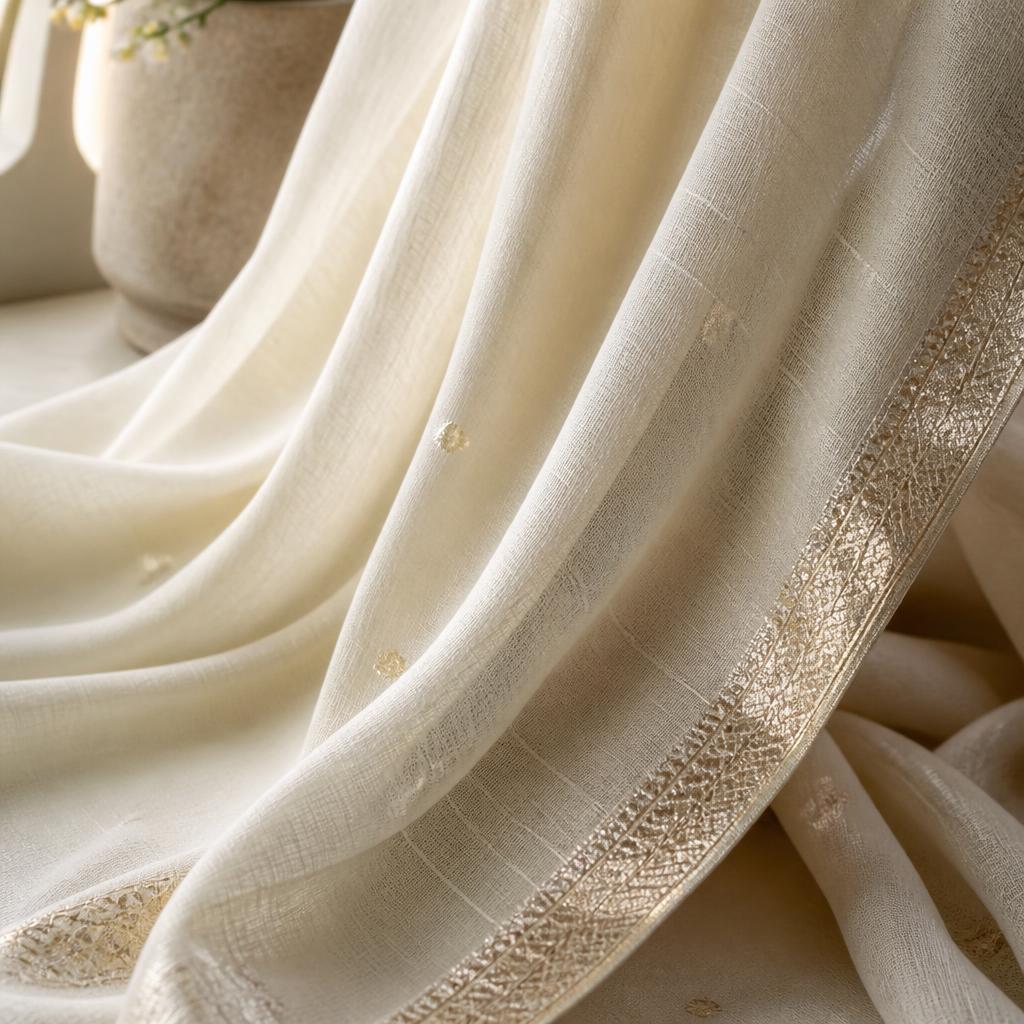
Chanderi is one of the few Indian weaves that reads as luxury without any surface work at all. The glassy transparency, the faint shimmer that moves as the wearer moves, the crisp fall that never quite collapses — all of it comes from the yarn and the loom, not from embellishment. That is exactly why choosing it badly is so costly: there is nothing to hide behind.
Most buying mistakes with Chanderi happen at the swatch stage, when a piece is judged on colour and price rather than on the three things that actually determine how a garment behaves — the fibre blend, the yarn count, and whether the sericin has been left in the warp. This guide walks through what to inspect, what to ask a weaver, and how to brief a Chanderi order so bulk matches the sample you approved.
Know which Chanderi you are actually buying
The name covers at least three distinct constructions, and they do not behave alike. Pure silk Chanderi uses silk in both warp and weft and gives the highest lustre and the most fluid drape. Silk-cotton Chanderi — the classic — runs a silk warp with a fine cotton weft, producing the characteristic transparency with a drier, crisper hand. Cotton Chanderi is the most breathable and the most matte, and it is the right choice for daywear and summer resort lines.
Ask which construction you are looking at before you discuss price. A silk-cotton piece quoted against a pure silk expectation is the single most common source of disappointment in bulk delivery.
- Pure silk Chanderi — maximum sheen, fluid fall, occasion and bridal layers
- Silk-cotton Chanderi — transparent, crisp, the classic saree and kurta cloth
- Cotton Chanderi — matte, breathable, ideal for summer and prêt
Read the transparency, not the thinness
Genuine Chanderi transparency comes from un-degummed yarn: the natural sericin is retained in the warp, so the filament stays glassy rather than soft. Hold the cloth against a window. You should see an even, luminous translucence with the butti sitting cleanly on top of it — not a cloudy haze, and not thin patches where the reed has drifted.
Thinness is a different property. A poorly counted cloth can be thin and still opaque, or gauzy and still lifeless. What you want is a fabric that is light in the hand but has spring — release a crushed corner and it should recover, not stay creased.
Judge the zari before you judge the design
In Chanderi, the butti is woven, not printed or embroidered, so the quality of the zari determines both the look and the longevity of the piece. Tested zari holds colour through wear; cheaper metallics oxidise and dull within a season, which is a serious problem on a garment sold at couture price.
Turn the fabric over. On honest handloom Chanderi the reverse shows the floats and the tie-offs of each motif. A perfectly clean reverse usually means a powerloom or an embroidered imitation — not necessarily wrong for your programme, but it should be priced as such.
- Ask whether the zari is tested and what its metal content is
- Check motif alignment across the full width, not just at the selvedge
- Confirm whether the piece is handloom or powerloom in writing
Match the Chanderi to the garment, not the mood board
Because Chanderi is sheer, almost every construction needs a lining decision made at the design stage rather than at sampling. A silk-cotton Chanderi kurta wants a soft cotton or bemberg lining that will not fight the outer cloth's crispness. A pure silk Chanderi dupatta should be left unlined so the transparency does the work.
Structured silhouettes — collars, plackets, fitted bodices — need interlining chosen with care. Chanderi's low weight means a heavy fusible will telegraph through the face of the cloth and flatten the sheen permanently. Test the fusing on the actual production quality, never on a substitute.
Brief the order so bulk matches the swatch
Handloom means variation. That is the point of the cloth, but it needs to be bounded. A good Chanderi brief fixes the construction, the usable width, the GSM range, the zari specification and an agreed tolerance for shade movement across lots, then names a signed swatch as the reference.
Set your dyeing sequence early too. Chanderi takes pastels and jewel tones beautifully, but deep saturated shades on a silk-cotton base can shift after finishing. If a colour is critical to the collection, run a lab dip on the exact quality before you commit yardage.
- Fix construction, width, GSM band and zari spec in the purchase order
- Approve a signed swatch and keep a counter-sample in house
- Run lab dips on the production quality before bulk dyeing
- Allow realistic loom time — good Chanderi cannot be rushed
- Confirm the construction — pure silk, silk-cotton or cotton — before anything else.
- Luminous transparency and spring in the hand signal un-degummed, well-counted yarn.
- Zari quality and the reverse of the cloth tell you more than the front does.
- Decide lining and interlining at design stage, and test on the real quality.
- Bound handloom variation with a written spec, a signed swatch and lab dips.
Bring the question to the studio
Reading only takes you so far. Handle the cloth, compare qualities side by side, and let us build the fabric plan for your collection with you in Ahmedabad.