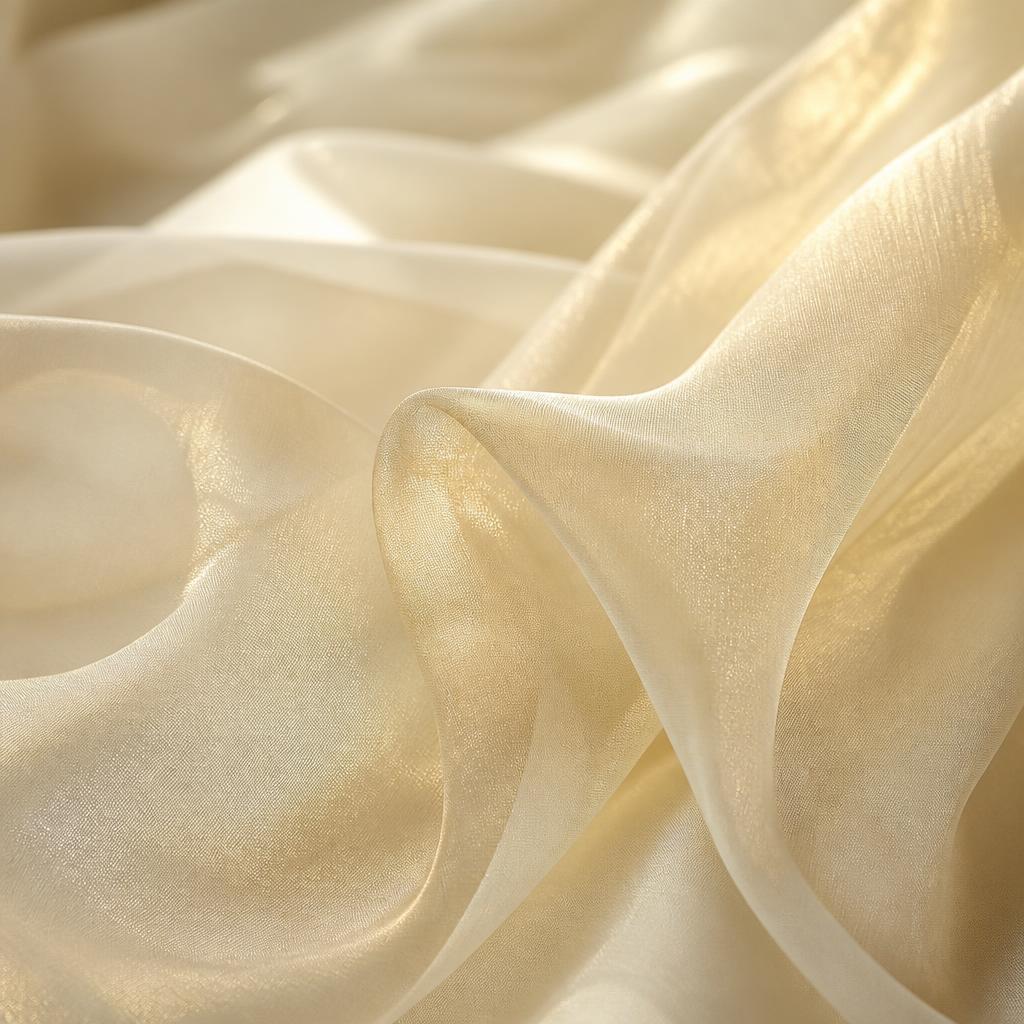
Organza Fabrics
The crisp sheer that holds air — silk, polyester and tissue organza for volume, structure and light in occasion wear.
- Weave
- Plain, tightly woven, high twist
- Variants
- Silk, polyester, tissue, shimmer
- Signature
- Crisp body with transparency
- Typical weight
- Very light, 25–60 GSM
Organza is a plain-weave fabric made from tightly twisted filament yarn, traditionally silk, and its defining quality is stiffness in a nearly weightless cloth. Where chiffon and georgette fall, organza stands. That structural memory is why it dominates sculptural sleeves, exaggerated ruffles, self-supporting bows and any silhouette that needs to hold air rather than trace the body.
The practical decision is fibre. Silk organza has the finest hand, a warm natural lustre and the best behaviour under an iron; it is also the most expensive and the most vulnerable to water spotting. Polyester organza is far more affordable, holds pleats and heat-set shapes brilliantly, resists creasing and is the standard base for large-volume occasion production. Tissue organza carries a metallic slub for shimmer, and shimmer or foil-treated organzas add surface interest at the cost of some softness. A designer who specifies simply 'organza' will get one of these, and the difference in cost and behaviour is significant — so we always confirm which.
Characteristics of organza
Crispness
The high-twist yarn gives spring and body — folds stand rather than collapse.
Transparency
Genuinely sheer, so seams, linings and construction are part of the visual design.
Weight
Among the lightest fabrics in the studio; large volumes stay wearable.
Shape retention
Polyester versions hold heat-set pleats and sculpted forms almost indefinitely.
Surface
Clean and glassy, with tissue and shimmer variants adding metallic depth.
Handling note
Fine and slippery to cut; seam finishes are best planned as visible details.
Where organza is used
It is a structure fabric first and a surface fabric second.
- Sculptural sleeves, ruffles, bows and dramatic capes
- Occasion and cocktail dresses with volume
- Saree and lehenga overlays that add light without weight
- Dupattas and stoles, plain or embroidered
- Interlining and underlay to lift a heavier outer fabric
- Embroidered panels where sheerness makes work appear to float
Sourcing organza through VPAS ANANT
We keep the full fibre range so the base can be chosen for behaviour and budget rather than availability.
- Silk, polyester, tissue, shimmer and foil organza under one supplier
- Weight and stiffness selection — soft-finish organza where crispness would fight the silhouette
- Shade matching across organza and its companion lining or outer fabric
- Pleating, crushing and heat-set treatments to a supplied sample
- Digital print and embroidery on a stabilised base
- Bulk metreage with consistent stiffness across the lot
Customisation available on this fabric
Custom Dyeing
Sheer bases read colour differently in single and double layer, so we approve dips on the layered mock-up you will actually use.
Digital Printing
Print on organza needs a stabilised run and colour compensation for transparency; strike-offs are mandatory.
Embroidery
Sequin, thread and cutwork on organza, backed and stabilised so the sheer ground does not distort.
Pleating & Texturing
Heat-set pleats, crush and fan textures — most durable on polyester bases.
Foil & Shimmer
Metallic foil and tissue variants for festive collections needing controlled sparkle.
Bulk Supply
Roll-consistent stiffness and shade across bulk, checked before dispatch.
See the full range of our capabilities or read how a programme runs from brief to bulk.
Why source organza from us
Fibre clarity
Silk versus polyester is stated on every quote — the cost gap is too large to leave vague.
Behaviour matching
We recommend stiffness against your silhouette instead of selling whatever is in stock.
Processing in-house network
Print, embroidery and pleating handled on the same base we supplied, so nothing shifts between vendors.
Consistency in bulk
Sheer fabrics show variation mercilessly; we check lots for uniform hand and shade.
Frequently asked
What is the difference between silk and polyester organza?
Silk organza has a finer hand, natural lustre and better iron tolerance, at a much higher price. Polyester organza is affordable, crease-resistant and holds heat-set pleats far better, which is why most volume occasion production uses it.
Is organza see-through?
Yes. It is a sheer by definition, so garments either use lining or treat the transparency as part of the design — layered panels, sheer sleeves or overlays on an opaque base.
Can organza be printed and embroidered?
Both, with care. Printing requires a prepared base and colour compensation for transparency; embroidery requires backing so the sheer ground does not pucker. We sample before bulk in either case.
Does organza wrinkle?
Silk organza creases and needs a low, dry iron. Polyester organza is highly crease-resistant and recovers well from folding, which also makes it easier to ship.
What weight of organza should I choose?
Lighter, softer organza suits gathers and fluid layering; stiffer, heavier organza suits standing ruffles and sculpted volume. Send a silhouette sketch and we will send matching swatches.
Browse the full fabric catalogue or see the industries we serve.
- Premium Fabric Supplier in AhmedabadCurated premium cloth, swatches and development from our Bopal studio.
- Textile Supplier in AhmedabadGreige to finished across cotton, silk, linen, viscose and blends.
- Textile Sourcing Partner in GujaratCluster selection, vendor vetting and inspection across the state.
- Designer Fabric Supplier across IndiaSwatches couriered and bulk dispatched to labels nationwide.
Enquire about organza
Tell us the silhouette and we will match fibre, stiffness and shade — with swatches before you commit to bulk.