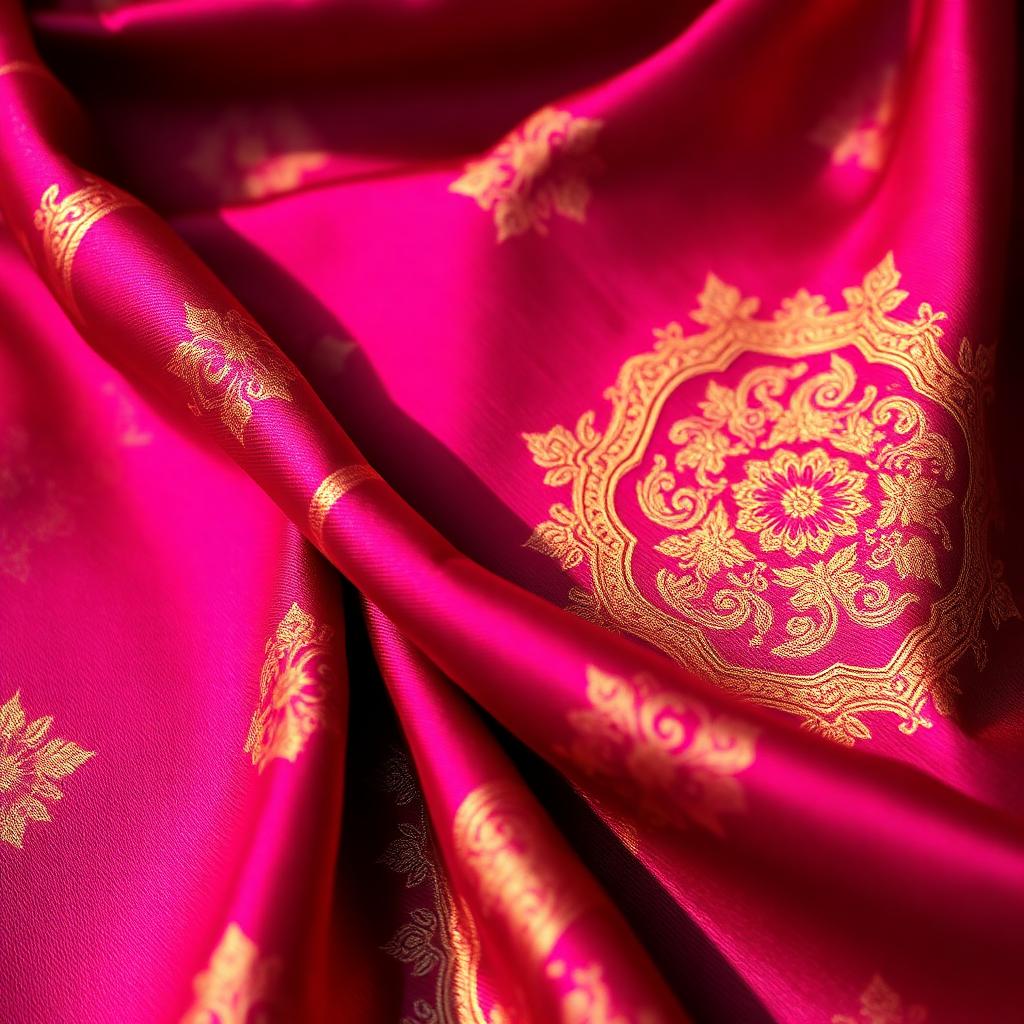
Banarasi Fabrics
Varanasi's brocade tradition — silk grounds carried with zari and resham figuring, from featherweight tissue to bridal-weight kadhwa work.
- Origin
- Varanasi, Uttar Pradesh
- Technique
- Brocade — kadhwa, fekuwa, cutwork
- Ground
- Katan, georgette, organza, tissue
- Ornament
- Zari and resham figuring
Banarasi is not a single fabric — it is a weaving tradition applied to several grounds. What unifies it is supplementary-weft figuring: extra weft threads of zari or resham carried across a silk base to build motifs. The Mughal-derived vocabulary of shikargah hunting scenes, jangla vines, jaal lattices and the ubiquitous buta and konia corner motifs still dominates, though contemporary designers commission geometrics and minimal butis with equal success.
The commercial distinction that matters most is how the motif is woven. In kadhwa work each motif is woven separately with its own weft, so the reverse is clean and no float threads run behind the ground — it is slower, costlier and far more durable. In fekuwa (cutwork) the weft is thrown across the full width and the floats are cut away afterwards, leaving a faint trace on the reverse; it is quicker and considerably cheaper. Neither is wrong, but a buyer who is quoted a fekuwa price and expects kadhwa quality will be disappointed. We specify the technique, the ground and the zari grade before anything is committed.
Characteristics of Banarasi
Weight and body
Ranges widely — katan silk brocade is substantial and holds structure; georgette and organza Banarasi stay fluid.
Zari figuring
Metallic yarn worked into the weave gives depth that surface embellishment cannot reproduce.
Reverse side
Kadhwa reads cleanly on the back; fekuwa shows cut float marks. A quick reliability check when buying.
Motif density
From sparse butis on a plain ground to jangla coverage where the ground barely shows.
Lustre
Pure silk grounds carry a deep, liquid shine that intensifies against zari.
Handloom variance
Small irregularities in a handwoven piece are evidence of the process, not defects.
Where Banarasi is used
Predominantly a bridal and high-occasion cloth, and increasingly used in panels rather than whole garments.
- Bridal lehengas, blouses and heavily figured borders
- Wedding sarees in katan, georgette and tissue grounds
- Sherwanis, bandhgalas and festive menswear
- Structured jackets, capes and occasion separates
- Panelled couture where brocade is used as accent rather than field
- Bespoke gifting stoles and dupattas
Sourcing Banarasi through VPAS ANANT
Brocade is bought on specification, not on photograph. We put the variables in writing before an order is placed.
- Choice of ground: katan silk, georgette, organza, tissue or blended base
- Kadhwa or fekuwa weaving specified and priced separately
- Zari grade declared — tested (real), half-fine or metallic imitation
- Custom motif and jaal development on graph before loom set-up
- Exclusive designs held for your label within an agreed period
- Panel, border and repeat layouts planned to your cutting plan to avoid waste
Customisation available on this fabric
Custom Dyeing
Ground dyeing to your shade before figuring, so zari sits against the exact colour you approved.
Digital Printing
Print layered over lighter Banarasi grounds for contemporary hybrid pieces; sampled before bulk.
Embroidery
Zardozi, dabka and sequin work added over brocade for bridal weight, planned around motif placement.
Fabric Finishing
Gentle finishing only — heavy processes damage zari and flatten the figuring.
Sampling
Loom samples of the actual motif at the actual scale, not a scaled artwork print.
Bulk Supply
Multi-loom scheduling for bridal season, with staged dispatch as pieces come off the loom.
See the full range of our capabilities or read how a programme runs from brief to bulk.
Why source Banarasi from us
Technique transparency
We tell you whether a piece is kadhwa or cutwork — the single biggest driver of price and longevity.
Zari honesty
Real, half-fine and imitation zari are quoted as what they are, so your costing and claims stay accurate.
Design development
Custom graphs and motif work handled with weavers on your behalf, from sketch to loom.
Season planning
Bridal demand spikes; we book loom time ahead rather than scrambling in October.
Frequently asked
What is the difference between kadhwa and cutwork Banarasi?
In kadhwa, each motif is woven individually with its own weft, giving a clean reverse and better durability. In cutwork (fekuwa), the weft runs across the width and floats are cut away afterwards. Kadhwa costs more and lasts longer; cutwork is faster and cheaper.
Is the zari real gold?
Rarely, and only in tested zari at a substantially higher price. Most contemporary Banarasi uses half-fine or metallic imitation zari. We state the grade on the quotation so there is no ambiguity.
Can you weave a custom Banarasi design?
Yes. We develop the motif on graph, produce a loom sample for approval, then set up for bulk. Development adds lead time, so plan several weeks ahead of your production date.
How do I care for Banarasi fabric?
Dry clean only. Store folded in muslin rather than plastic, refold along different lines periodically to avoid permanent creases at the zari, and keep away from prolonged direct light.
Do you supply Banarasi by the metre?
Yes, alongside saree and dupatta pieces. Metre supply is common for lehengas, blouses and panelled couture; tell us your cutting plan and we will advise on the most economical layout.
Browse the full fabric catalogue or see the industries we serve.
- Premium Fabric Supplier in AhmedabadCurated premium cloth, swatches and development from our Bopal studio.
- Textile Supplier in AhmedabadGreige to finished across cotton, silk, linen, viscose and blends.
- Textile Sourcing Partner in GujaratCluster selection, vendor vetting and inspection across the state.
- Designer Fabric Supplier across IndiaSwatches couriered and bulk dispatched to labels nationwide.
Enquire about Banarasi
Share your ground, motif direction, zari preference and quantity. We will send options with a clear technique and price breakdown.