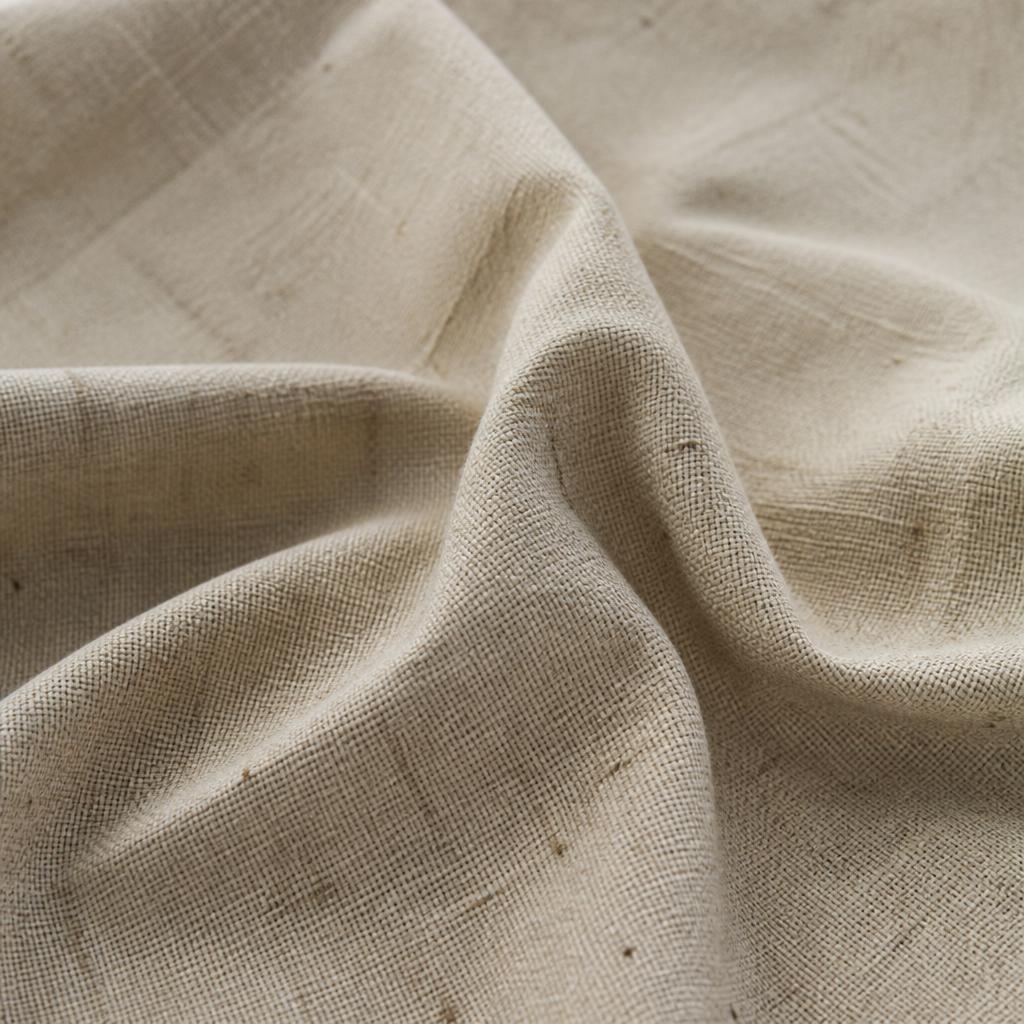
Khadi Fabrics
Hand-spun, hand-woven cloth with genuine provenance — cotton, silk and wool khadi sourced from spinning and weaving clusters, not mill imitations.
- Definition
- Hand-spun yarn, hand-woven cloth
- Types
- Cotton, silk (khadi silk), wool
- Texture
- Irregular, breathable, self-textured
- Widths
- Often narrower — plan cutting accordingly
Khadi is defined by process, not by look. The yarn must be hand-spun, usually on a charkha, and the cloth must be hand-woven. That double handwork produces a fabric with an open, irregular structure that traps air, which is why khadi feels cool in summer and surprisingly warm in winter. Much of what is sold as khadi is actually mill-spun yarn on a handloom — a perfectly good fabric, but it is khadi-effect handloom rather than khadi, and it should be priced and described as such.
Cotton khadi is the most common, ranging from coarse, characterful counts to remarkably fine muslin-like qualities. Khadi silk blends hand-spun silk with cotton for a subtle sheen over a textured ground and has become a favourite for contemporary occasion wear. Woollen khadi from the northern belt suits winter shawls and jackets. Because looms are individual and widths are often narrower than mill standard, khadi needs to be planned into a cutting layout early. We will confirm the actual usable width per lot rather than assuming a standard.
Characteristics of khadi
Self-texture
Irregular hand-spun yarn gives a living surface no power loom reproduces convincingly.
Air permeability
The open structure breathes exceptionally well and moderates temperature both ways.
Softening
Starts firm and softens markedly over the first several washes.
Low-impact
Minimal machine energy in production, with natural-dye options available on many qualities.
Width variance
Loom widths vary between clusters; usable width is confirmed per lot.
Batch character
Small differences between weavers are inherent — a provenance marker, not a defect.
Where khadi is used
It anchors slow-fashion and craft-forward collections, and increasingly appears in contemporary tailoring.
- Kurtas, shirts and relaxed everyday ethnic wear
- Slow-fashion and sustainable capsule collections
- Jackets, waistcoats and structured khadi tailoring
- Sarees, dupattas and stoles in khadi cotton and khadi silk
- Natural-dye and hand-block programmes on a khadi ground
- Institutional and heritage uniform programmes
Sourcing khadi through VPAS ANANT
Because khadi is a livelihood as well as a material, we buy at the cluster and plan around real weaving capacity.
- Genuine khadi sourced from spinning and weaving clusters, with provenance stated
- Khadi-effect handloom offered separately when budget or volume demands it
- Counts from coarse and characterful to fine muslin-weight
- Khadi silk and khadi wool for occasion and winter programmes
- Natural and azo-free dyeing where the collection story requires it
- Staged bulk planning across looms, with realistic weaving lead times
Customisation available on this fabric
Natural Dyeing
Indigo, madder, myrobalan and iron-based natural dyeing on khadi, with the shade variation those dyes naturally carry.
Custom Dyeing
Azo-free reactive dyeing for consistent commercial shades where natural dye variance is not wanted.
Hand Block Printing
Khadi is an ideal block-printing ground; its texture gives block work a depth flat mill cloth cannot match.
Embroidery
Kantha, aari and thread embroidery worked on khadi grounds for craft-led pieces.
Finishing
Calendering or soft washing to take the edge off loom-state stiffness without flattening the texture.
Bulk Supply
Cluster-planned bulk with staged dispatch, since hand-spinning and hand-weaving set the pace.
See the full range of our capabilities or read how a programme runs from brief to bulk.
Why source khadi from us
Real versus effect
We distinguish true hand-spun khadi from mill-yarn handloom on every quotation.
Cluster relationships
Direct buying supports artisan income and gives us early sight of capacity.
Width confirmed per lot
We measure and report usable width so your marker plan is not built on an assumption.
Craft-aware processing
Dyeing and printing routed to units that understand handwoven cloth.
Frequently asked
What exactly makes a fabric khadi?
Both the spinning and the weaving must be done by hand — hand-spun yarn on a handloom. Mill-spun yarn woven on a handloom is handloom fabric, not khadi, even though it can look similar.
Is khadi only cotton?
No. Khadi cotton is most common, but khadi silk (often a hand-spun silk-cotton blend) and woollen khadi are both produced and both available through us.
Does khadi shrink?
Yes, typically more than mill cotton on the first wash, and it softens considerably at the same time. We recommend pre-washing sample yardage before finalising patterns, and we state tested shrinkage per lot.
Why does khadi cost more than mill cotton?
Two hand processes replace two machine ones. Hand-spinning alone takes hours per hank, and that labour — plus the artisan income it sustains — is what you are paying for.
Can khadi be supplied in bulk?
Yes, with planning. Output is limited by loom and spinner availability, so bulk is scheduled across a cluster and dispatched in stages. Share your quantity and date and we will confirm a realistic plan.
Browse the full fabric catalogue or see the industries we serve.
- Premium Fabric Supplier in AhmedabadCurated premium cloth, swatches and development from our Bopal studio.
- Textile Supplier in AhmedabadGreige to finished across cotton, silk, linen, viscose and blends.
- Textile Sourcing Partner in GujaratCluster selection, vendor vetting and inspection across the state.
- Designer Fabric Supplier across IndiaSwatches couriered and bulk dispatched to labels nationwide.
Enquire about khadi
Tell us the count, colour direction and quantity. We will confirm provenance, usable width and a weaving schedule you can plan against.