Silk vs Organza
One is a fibre, the other is a construction — and confusing the two is why sheer garments so often fail at fitting.
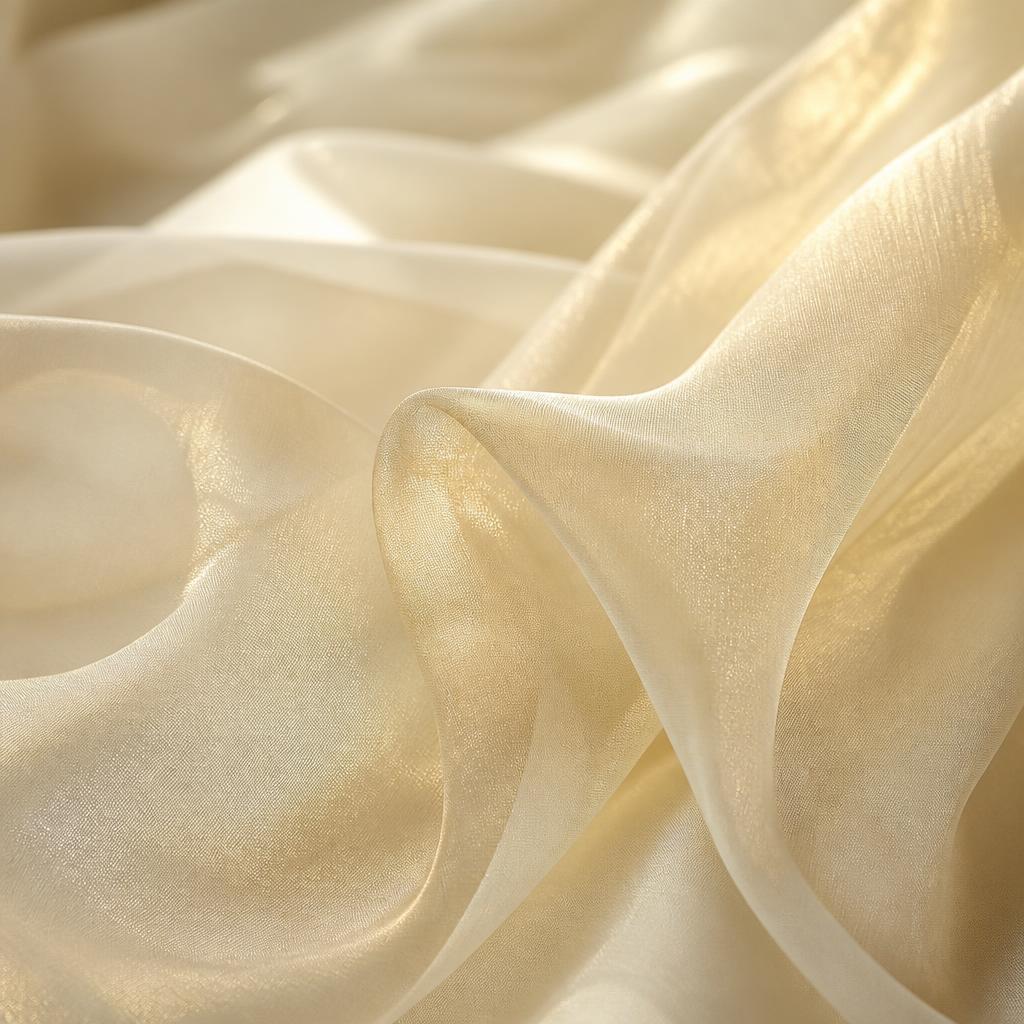
Silk is a fibre spun by the silkworm. Organza is a plain-weave construction of tightly twisted, thin filament yarns that produces a sheer, wiry, self-supporting cloth. You can have silk organza, polyester organza and viscose organza — and you can have silk that behaves nothing like organza at all.
Once the distinction is clear, the design decision becomes simple: are you asking the cloth to fall, or to hold?
Silk as a fibre family
Under the single word silk sits a wide range of behaviours. Mulberry silk charmeuse is fluid and reflective; dupion is slubbed and papery; crepe de chine is matte with weight and swing; taffeta is crisp and rustling. What they share is the protein filament — the reason silk breathes, takes dye with extraordinary depth, and warms to the body.
So when a supplier says silk, they have told you almost nothing about how it will drape. Ask for the construction and the weight before you plan a silhouette around it.
Organza as a construction
Organza is defined by its yarn and its openness. Very fine, highly twisted filaments woven at low density create a fabric that is transparent, extremely light, and — crucially — stiff. That stiffness is structural, not a finish; it survives washing and does not soften into fluidity with age.
Silk organza is the finest of the family: crisp with a subtle irregularity and a warm sheen. Polyester organza is more uniform, cheaper, harder in the hand, and available in a far wider range of shot and metallic effects. Both are legitimate — they simply do different jobs.
- Silk organza — warm sheen, natural irregularity, breathes, takes couture dyeing
- Polyester organza — uniform, glassy, economical, wide effect range
- Both hold shape; neither is a substitute for a fluid silk
Drape: the decisive difference
A silk charmeuse or crepe collapses gracefully around the body and reads as liquid. An organza of any fibre resists the body: it stands away, holds a sculpted volume, and creates the halo effect designers use for sleeves, capes, ruffles and structured overlays.
This is why substituting one for the other at the last minute destroys a design. A gown drafted for organza volume will hang limp in charmeuse; a bias-cut slip pattern cut in organza will not fall at all and will crease into hard folds.
Handling, sewing and finishing
Organza is unforgiving of needle marks — every stitch line is permanent, so fitting muslins matter more than usual. Use fine needles, French or bound seams, and press with a cool iron and a cloth. Silk crepes and satins, by contrast, are prone to seam slippage and water spotting, and are best stabilised at seams rather than pressed hard.
For sheer layering, remember that organza reads its lining. A white organza over a nude base is a completely different colour to the same organza over ivory — always approve sheers on the actual lining, never against a white table.
- Approve every sheer over its intended lining, not against white
- Organza holds needle marks — fit in a substitute cloth first
- Use fine needles and enclosed seams on both families
Choosing for a collection
If the garment's beauty lies in movement — a slip dress, a fluid saree, a bias gown — reach for a fluid silk. If it lies in volume, silhouette and light — a dramatic sleeve, a layered lehenga, a translucent overlay above embroidery — reach for organza.
Many of the strongest pieces do both: an organza structure over a silk interior, so the garment holds its architecture while remaining soft against the skin. That pairing is worth swatching together before it is designed around.
- Silk is a fibre; organza is a construction available in several fibres.
- Fluid silks collapse and flow; organza stands away and holds volume.
- Silk organza breathes and has warmth; polyester organza is uniform and economical.
- Never approve a sheer against white — approve it over its actual lining.
- Pairing organza structure with a silk interior gives shape without stiffness.
Bring the question to the studio
Reading only takes you so far. Handle the cloth, compare qualities side by side, and let us build the fabric plan for your collection with you in Ahmedabad.